
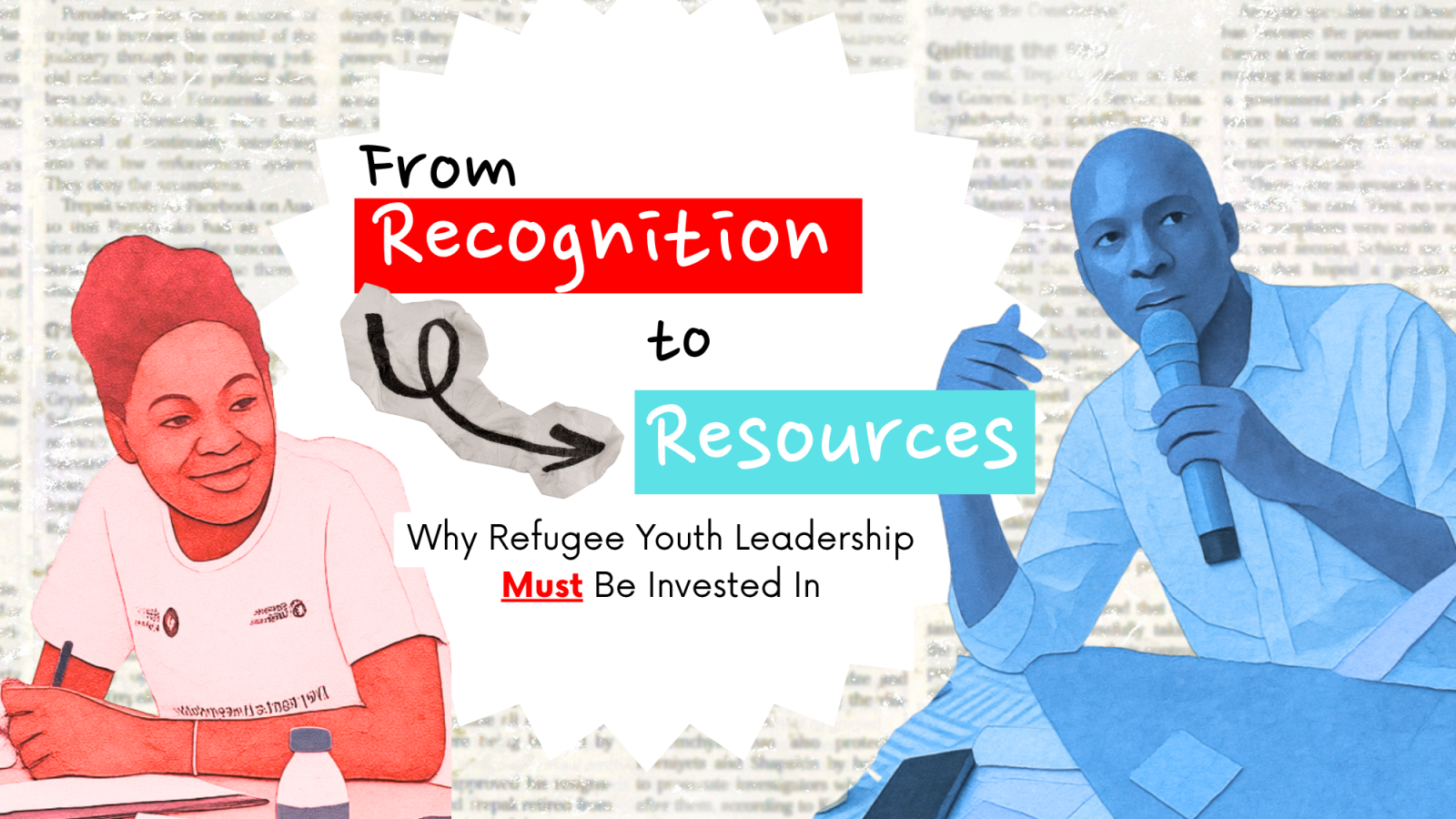
Across refugee settlements, urban communities, and displacement contexts worldwide, refugee youth are already leading. They are organizing community initiatives, supporting new arrivals, promoting education, advocating for protection, documenting stories, responding to crises, and creating solutions to challenges affecting their communities.
In this context, Refugee Youth-Led Organizations (RYLOs) refer to formal or informal community-based groups created and led by refugee youth, often between the ages of 18 and 30. Some are registered organizations, while others operate informally due to legal, administrative, or documentation barriers. Regardless of their registration status, they play a distinct and complementary role within the wider refugee leadership ecosystem.
They are not waiting to become leaders.
They already are.
The challenge is that while refugee youth leadership is frequently celebrated, it is rarely resourced.
Too often, refugee youth are invited to share their experiences but excluded from decisions that shape humanitarian responses. They are consulted but not trusted with resources. They are recognized as community mobilizers but struggle to access funding, partnerships, and opportunities to scale their work.
This contradiction continues to undermine efforts toward meaningful localization and youth participation.
While many of the challenges facing refugee youth overlap with those experienced by young people more broadly, displacement creates additional barriers that cannot be ignored. Refugee young people often navigate legal identity and documentation challenges, restricted mobility, uncertain futures, limited access to education and livelihoods, and exclusion from decision-making spaces that affect their lives. Many refugee youth-led organizations also face difficulties accessing direct funding, humanitarian coordination mechanisms, and policy processes despite being closest to affected communities. These realities make investment in refugee youth leadership not only a question of inclusion, but also of equity and justice.
For many RYLOs, access to funding is also limited by the assumption that only formally registered organizations can be legitimate partners. In practice, many refugee youth-led groups are informal because registration is difficult, costly, or impossible in their contexts. In some cases, even registered groups struggle to open organizational bank accounts, creating additional barriers to receiving and managing funds.
If the humanitarian sector is serious about shifting power, supporting local leadership, and creating sustainable solutions, then refugee youth leadership must move beyond symbolic inclusion and become a genuine investment priority.
Investing in refugee youth leadership is not simply about funding projects. It is about investing in people, ideas, relationships, and long-term community resilience.
Refugee youth possess deep contextual knowledge of the realities affecting their communities.
They understand the barriers young people face in accessing education, livelihoods, protection, and participation because they experience those realities themselves. This lived experience positions them not only as beneficiaries of humanitarian action but as critical actors in designing and leading effective responses.
When refugee youth are equipped with resources, mentorship, skills development, and opportunities for decision-making, communities benefit. Local initiatives become stronger, responses become more relevant, and solutions become more sustainable.
Yet many refugee-led organizations continue operating with limited resources, relying on volunteers and short-term support to address challenges that require long-term investment.
The question is therefore not whether refugee youth are capable of leading.
The question is whether the humanitarian system is willing to invest in that leadership. This year's conversations on refugee youth leadership and financing have highlighted a simple but important reality: recognition without resources is not enough.
Supporting refugee youth leadership requires more than inviting young people to conferences, consultations, and panels. It requires direct investment in refugee-led organizations, accessible funding mechanisms, meaningful partnerships, capacity strengthening, and opportunities for young people to influence decisions that affect their lives and communities.
It also requires addressing the structural barriers that continue to limit refugee youth participation and leadership. This includes creating pathways for refugee youth to engage in policy and humanitarian coordination spaces, supporting access to documentation and mobility opportunities where possible, investing in leadership and wellbeing, and building long-term partnerships that move beyond short-term projects or symbolic engagement. If we are serious about shifting power, refugee youth must not only be consulted but they must be trusted, resourced, and supported to lead.
This also means meeting RYLOs where they are. Rather than expecting refugee youth-led organizations to immediately meet systems designed for larger and more established NGOs, donors and partners should adapt funding, due diligence, reporting, and capacity-strengthening processes to the realities of youth-led groups.
As we reflect on World Refugee Day, we must move beyond celebrating resilience and begin addressing the conditions that make resilience necessary in the first place.
Refugee youth do not need to be continuously empowered by others. They need systems that trust them, invest in them, and remove barriers that prevent them from leading.
The future of humanitarian action depends on local leadership. Refugee youth are already demonstrating what that leadership looks like every day. The challenge before us is whether we are prepared to match our words with resources. Because celebrating refugee youth leadership is important. Investing in it is even more important.